Top 2 Best Beef Cows Japan
From the unique marbling of the beef to the limited export market, Japanese Wagyu cattle have sparked intrigue and a growing post-obit in the U.S.
Whether a large producer or a homesteader raising beef for the family, cattle-folks know the value of marbling their meat. Only in add-on to the large breeds and then well known to American beef producers, a number of foreign lines have fabricated their way into the herds over years — and among the all-time in terms of marbling quality is the Japanese Wagyu. Literally translating as "Japanese Cow" (Wa = Japanese, Gyu = cow), the breed was first introduced to the U.S. in 1976, and today boasts most 40,000 American head, crosses included. Considered a effeminateness in Nihon, where it fetches as much equally $150 per pound, American producers similar crossing the Wagyu with Angus and Holstein.
Whether a consumer or a producer, introducing some Asian claret into the herd might exist worth the consideration. And as it'south not a breed with which many Americans are familiar, here are vi Japanese Wagyu cattle facts to assistance get you started. This isn't intended to be an exhaustive summary of the brood, but they should wet the tastes of those interested and who desire a primer on it. For more in-depth information, visit some of the additional resources the American Wagyu Clan
1. Interesting history
Getting your hands on pure Wagyu has been tough over the years. Alive animal and DNA transport from Japan was banned prior to, and after 1997, making for a pocket-size window in the breed's history. In fact, the meat itself was really banned for export up until 2012, and even now there is a strong quota and tariff system in consequence. Of the head in America today, but about 26,000 are purebreds, out of some 89.nine one thousand thousand total cattle.
Still, there is DNA in the Western Hemisphere for producers interested. In 1976, four bulls were sent from Japan to the outside world, and Colorado University obtained semen collections, which were after sold to Wagyu Breeders Inc. Equally at that place were no Wagyu females in the U.S. at the time, the two Wagyu Black and 2 Wagyu Red bulls were bred to Angus, Hereford, and Brangus cows out of Texas. Generations later though, producers tin get a purer strain by style of the numerous Wagyu associations that have developed at present around the earth.
For more than information on how to obtain pure genetics, check out the Breeders Guide of the American Wagyu Association or Wagyu International.
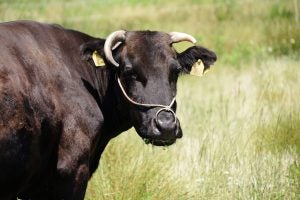
ii. The fab four
In Nihon, the brood maintains four groupings: Japanese Black, Japanese Brown, Japanese Shorthorn, and Japanese Polled. Prior to the 20th century, the Japanese Blackness cattle were considered the workhorses of that islands farms. Improved through the years by crossbreeding with foreign cattle, that group at present accounts for xc percent of Wagyu raised in Japan, with a slaughter age of 28 to 30 months and boilerplate grade there of BMI 5.6. The Japanese Brown on the other paw tends to produce a lower fat content and bacteria meat, with an boilerplate Japanese Class of BMS iii.2 and slaughter age of 25 months. The Japanese Shorthorn comes primarily from the Tohuku Region and is the event of long series of mating interactions with the Nanbu Cattle. Much bacteria than the Japanese Blackness, the Shorthorn has a BMS of iii or below. The youngest of the breeds is the Japanese Polled, which was created by crossing the Aberdeen Angus from Scotland with the Japanese Black in 1920. The smallest of the four, the Japanese Polled is also the leanest of the four.
3. Size matters
Numbers will vary amid producers, simply a study published in the Asian-Australasian Journal of Fauna Sciences recorded mean body and carcass weights of Japanese Black cattle at slaughter to be 756 kilograms (1,666.69 pounds) and 476 kilograms (1,049.40 pounds), at 29.two months of historic period. Mean daily weight gain to slaughter was 0.77 kilograms (one.697 pounds).The same 2018 written report showed 26-calendar month one-time Wagyu steer carcasses to exist 47.7 pct musculus, 41.7 pct fat, and 10.six pct bone, which represented the highest level of fat when compared to Belgian Blue cattle, Holstein, and High german Angus.
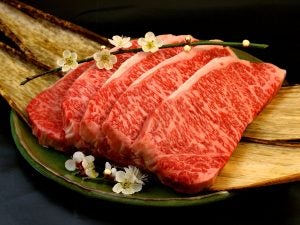
4. Fatty and juicy
With up to 300 per centum more monosaturated fat than other beef, the Wagyu beef is significantly college in Omega 3 and 6 content as well, and has the highest amount of conjugated linoleic acrid (CLA) per gram relative to other beef by a factor of 30 percent due to linoleic acid levels. To that degree, the beef has a fat profile comparable to salmon and olive oil, while boasting lower cholesterol levels and so chicken. With stats like that, information technology's easy to understand why people depict the beef equally having a unique flavour and downright buttery feel. More than than 90 percent of Wagyu slaughtered in the U.South. are classified "Prime," which is the highest mark, with marbling described as "slightly abundant to abundant," with a minimum intramuscular fat content of 8 to eleven percent.
v. Where's the beefiness?
While not available just anywhere in the U.S., a number of brick-and-mortar locations do retail Wagyu beef, and there are several online. Prices vary widely by retailer, as with all products. Serpent River Farms of Idaho is one of many operations specializing in Wagyu, with a number of cuts and majority provisions available through their website. Prices for products range anywhere from $14 per pound for basis beef, to $399 for prime rib. Traditional brick-and-mortar options include Costco, with 10-packs of x-pound basis beef going for $99.99. For producers looking to incorporate the Wagyu into their own herd, the American Wagyu Association offers a number of contacts.
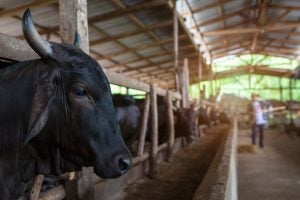
vi. Wagyu myths
Because of the express exports, a number of downright hilarious myths accept arisen to explain their loftier fat content. One of the more agreeable is that Japanese farmers massage their cows while feeding them beer and playing classical music to help them relax. All experts concur, this is manure spread about the diner. Observers of Japanese farms might have mistaken traditional brushing techniques for massage, and various grain concoctions might have an aroma to them, but the Wagyu farms are non day spas.
Curious about other breeds? Hither are seven facts nigh Black Angus cattle, vii facts nearly Hereford cattle, besides as a list of the most pop cattle breeds in the U.Southward.
Brian Boyce is an honor-winning author living on a farm in west-central Indiana. Y'all can come across more of his work at world wide web.boycegroupinc.com.
Sponsored Content on AGDaily
Source: https://www.agdaily.com/livestock/facts-about-japanese-wagyu-cattle/
0 Response to "Top 2 Best Beef Cows Japan"
Postar um comentário